
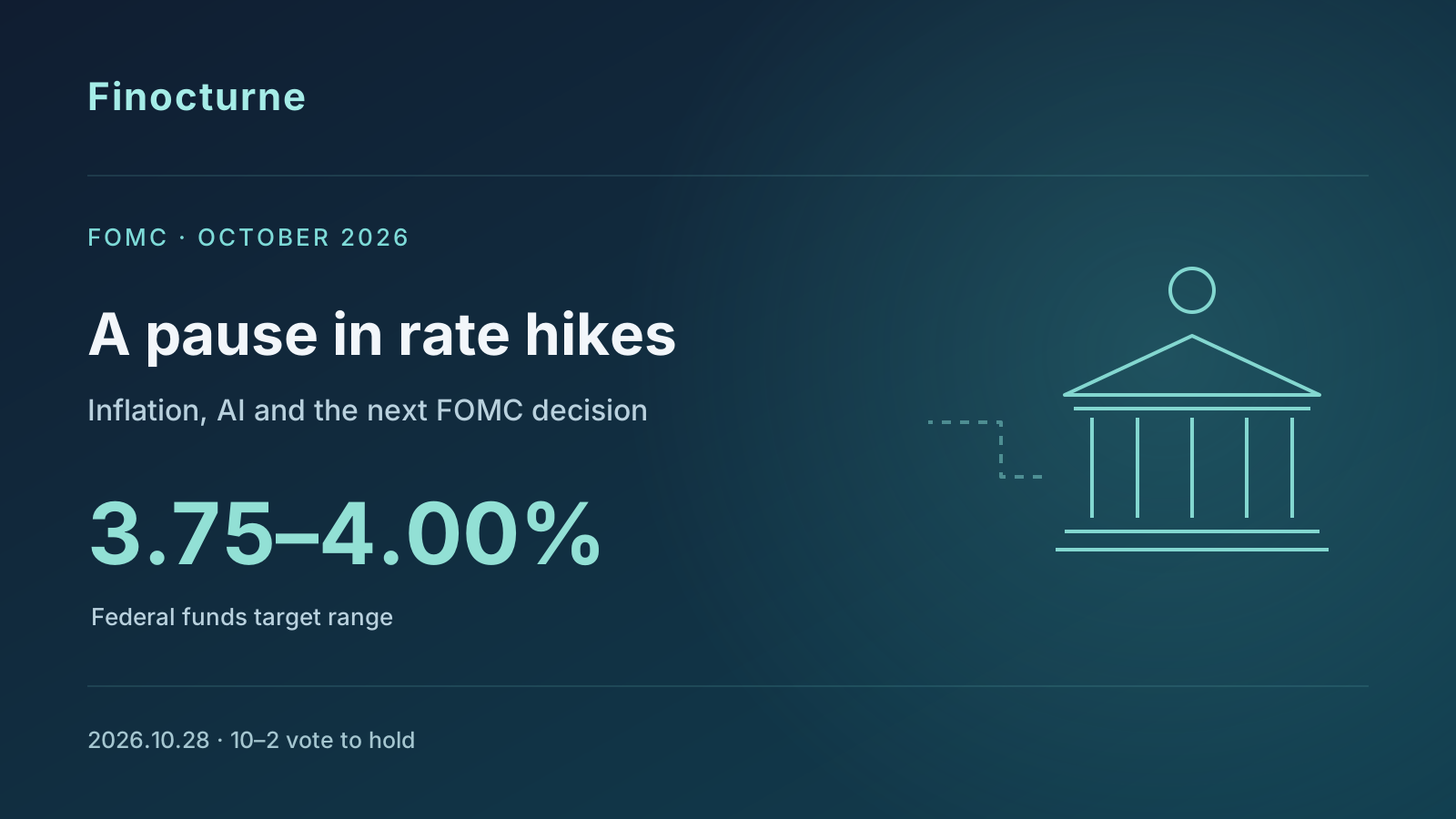
The U.S. Federal Reserve announced its latest rate decision on October 28, 2026, keeping the federal funds target range at 3.75%–4.00% rather than continuing September’s rate increase. Yet the U.S. economy was still growing strongly, inflation had not returned to the 2% policy target, and two officials favored another hike. With neither the economy nor inflation cooling noticeably, why did the Fed choose to pause?
Beyond the rate decision, Chair Kevin Warsh announced at his press conference that the Fed would change the arrangements for regular FOMC meetings beginning in 2027. Some meetings would be reserved for long-term monetary policy strategy rather than routine rate decisions. AI investment, productivity growth and future policy communication were also important topics. These changes concern not only how the Fed assesses the current economy, but also how markets may understand monetary policy in the future.
1. The Fed holds rates steady, pausing its sequence of increases
On October 28, the Federal Open Market Committee (FOMC) voted 10–2 to keep the federal funds target range at 3.75%–4.00%. This was the first pause in further increases following the 25-basis-point hike on September 16. Unlike September’s unanimous 12–0 decision, this meeting included dissenting views.
| Comparison | September 16 | October 28 |
|---|---|---|
| Rate decision | Increase of 25 basis points | Unchanged |
| Target range after the decision | 3.75%–4.00% | 3.75%–4.00% |
| Vote | 12–0 | 10–2 |
| Economic activity | Solid expansion | Strong expansion |
| Inflation assessment | Still elevated | Still elevated |
Notably, the October policy statement described economic activity as expanding at a strong pace, citing resilient domestic spending, continued productivity growth, robust capital investment and job gains broadly keeping pace with the workforce. The statement suggests that sudden economic weakness was not the reason for the pause. Nor did the Fed say that inflation had been resolved: it remained elevated, and officials emphasized the need for more information to determine the stance that would return inflation to 2% in a timely manner. Holding rates steady can therefore be understood as a period of observation after a hike, rather than a formal shift toward monetary easing. Whether the Fed raises rates again or maintains them at its next meeting depends on subsequent economic and price developments.
- Target lower bound
- Target upper bound
Source: Federal Reserve meeting statements, January 28–October 28, 2026; announcement dates, percent. Scheduled-meeting observations, not implementation dates or daily effective rates.
Chart data
| Observation | Target lower bound | Target upper bound |
|---|---|---|
| 2026-01-28 | 3.50% | 3.75% |
| 2026-03-18 | 3.50% | 3.75% |
| 2026-04-29 | 3.50% | 3.75% |
| 2026-06-17 | 3.50% | 3.75% |
| 2026-07-29 | 3.50% | 3.75% |
| 2026-09-16 | 3.75% | 4.00% |
| 2026-10-28 | 3.75% | 4.00% |
2. With inflation still above target, why wait?
When demand is strong and inflation persists above target, raising interest rates is generally an important central-bank tool for restraining price pressures. Why, then, did the Fed not increase rates again in October while the U.S. economy remained resilient? The key is that monetary policy does not have its full effect on the real economy immediately. A higher policy rate can feed through to bank loans, corporate financing and other financial products, influencing household consumption and business investment. Businesses do not immediately cancel every investment plan when rates rise, however, and consumers do not instantly change all their spending after an announcement. The effects on demand, employment and prices usually take time to emerge. Warsh noted that financial and credit conditions had begun tightening for some businesses and households after September’s increase, while saying he would not yet describe overall financial conditions as tight. The Fed was watching how existing policy was working rather than determining its next move from a single inflation release.
Continuing to raise rates before the full effects emerge could drive borrowing costs up too quickly and suppress investment and employment. Stopping tightening too early, however, could leave inflation above target. The question is not simply whether to hike, but how to judge the pace and timing of adjustments. Renewed energy-price increases have added uncertainty. Higher energy prices can directly raise transport and energy-related goods costs, but central banks are especially concerned about whether these shocks spread to other goods and services or alter inflation expectations. Warsh reiterated that the inflation target remained 2%, measured by the personal consumption expenditures price index (PCE), with no alternative standard tolerating persistently higher inflation. The pause should therefore not be read as acceptance of a higher inflation rate, but as a judgment that more information was needed before the next action.
3. Two officials wanted another hike: what does the disagreement reveal?
Another important change was dissent within the committee. Fed Governor Lisa Cook and Cleveland Fed President Beth Hammack opposed leaving rates unchanged and preferred another 25-basis-point increase. The disagreement matters because officials can assess the same broad economic environment while judging policy timing and risks differently. Officials more concerned about persistent inflation may consider further increases useful for restraining demand when growth is strong and employment remains resilient. Those favoring a pause may attach more weight to the transmission of the previous hike and the value of additional observation amid uncertainty. These are economic perspectives for interpreting the disagreement, not a claim that each dissenter explicitly offered all of these reasons.
The debate also reflects the trade-offs within the Fed’s dual mandate: price stability and maximum employment. When inflation is high but the labor market has not weakened noticeably, a hike may support price stability while increasing the risk of a later slowdown. Disagreement need not mean fundamentally different views of current conditions; officials may instead place different weights on inflation risk, transmission lags and the costs of excessive tightening. The 10–2 vote reminds markets that even an unchanged rate can coexist with continuing discussion of further tightening.
4. Can AI investment and productivity change the link between inflation and rate hikes?
Beyond inflation and employment, the AI investment boom was an important press-conference topic. Spending on data centers, semiconductors, computing equipment and related infrastructure has become an important driver of U.S. capital expenditure. Whether that investment raises inflation pressures or supports growth through greater productivity remains an open question. In macroeconomic terms, AI can influence both demand and supply. In the short run, construction, equipment purchases and infrastructure investment directly increase demand for capital goods and related services. If equipment, electricity or engineering capacity cannot expand quickly enough, costs may rise in particular sectors. Conversely, AI that improves operating efficiency, reduces unit production costs or enables the same workers and equipment to produce more can increase productive capacity. If supply capacity rises, stronger economic growth need not bring a proportionate rise in prices.
Warsh said U.S. productivity had shown signs of improvement, while acknowledging that productivity and potential growth are difficult to measure precisely. He did not regard strong growth alone as sufficient evidence of overheating. Importantly, he said some productivity improvements predated the recent AI boom, so not all gains should be attributed directly to AI. This complicates monetary-policy judgments: demand-driven growth may raise inflation concerns, whereas growth supported by productivity need not imply the same degree of overheating. AI investment is not immune to interest rates, however. Whether financed through loans, bonds or other channels, changes in rates affect the cost of capital and investment decisions. Even with substantial growth potential, businesses must assess whether future returns justify large initial expenditures. Fed task forces are also examining how technology affects productivity, jobs and inflation. Warsh announced a public hearing for November 16 to hear outside views on AI and the economy. These studies had not become new formal monetary policy, but they show why technological change increasingly matters in central-bank analysis.
5. Why will fewer regular meetings make rate decisions?
The more institutional development at this press conference, compared with the rate decision announced after every FOMC meeting, was a change to the use of future regular meetings.
Warsh said the FOMC would continue to hold eight regular meetings each year. Beginning in 2027, one would focus exclusively on longer-term monetary policy strategy, with neither a federal funds rate vote nor a conventional policy statement anticipated. For 2028, he expected two strategy meetings and six regular policy-setting meetings.
| Year | All regular meetings | Regular policy-setting meetings | Longer-term strategy meetings |
|---|---|---|---|
| 2026 | 8 | 8 | 0 |
| 2027 | 8 | 7 | 1 |
| 2028 (expected) | 8 | 6 | 2 |
The essential distinction is that the FOMC is not reducing its total meeting count, but reallocating the purposes of its meetings. Regular meetings have traditionally focused on current data, inflation and policy rates. Some future meetings would instead reserve time for longer-term questions, such as productivity, improvements to monetary tools and how a central bank should assess a changing economy. Institutionally, this would distinguish short-term rate decisions from longer-term policy research more clearly. Central banks must respond regularly to economic developments, but concentrating every meeting on the current rate level may limit the time available for deeper consideration of institutions and policy frameworks.
Fewer regular rate-decision dates could also create new issues. If a meeting at which markets previously expected a possible rate change becomes primarily a strategy discussion, investors will need to reassess the timing of adjustments. Major developments between policy meetings could increase attention to how the Fed preserves flexibility. This reform does not mean rates could be changed only at six or seven scheduled policy meetings. Under the Fed’s existing meeting arrangements, the FOMC can hold unscheduled meetings as economic and financial circumstances require, in addition to its eight regular meetings. Fewer scheduled rate decisions therefore do not remove its ability to respond to sudden developments. The 2028 arrangements also remain Warsh’s expected direction rather than a fully specified implementation: details and disclosure rules await further announcements. The change concerns the balance between timely decisions, strategic research and communication, not simply a revised calendar.
6. Without advance signals on rates, how should markets read the Fed?
Warsh’s approach to policy communication also differed from the signals markets have grown accustomed to. Asked whether a December hike remained possible, he declined to indicate the next decision in advance. Outside exceptional circumstances such as a financial crisis, he said he was not inclined to use forward guidance or prejudge future meetings before the data were complete. Forward guidance is one way central banks influence expectations. In addition to changing the current policy rate, a central bank can describe possible future policy to alter expected short-term rates, affecting longer-term yields, financing costs and financial conditions. Even with no hike today, medium- and long-term rates may reflect expectations of later increases. Conversely, new information that lowers expectations for future hikes can move market rates before the Fed takes formal action.
This is why markets care not only about the final choice to hike, cut or hold, but also about statement wording, the Chair’s press conference and other officials’ economic assessments. Warsh reiterated that he would not submit his own rate forecast to the Fed’s dot plot, while other participants would continue to offer their views. This does not mean the dot plot has been canceled; the Chair is choosing not to signal a particular policy path through an individual projection. Less explicit advance guidance may lead investors to pay more attention to inflation, employment and activity data, as well as different officials’ positions. Whether it increases volatility depends on the clarity of future communication, how data compare with expectations and how investors understand the new meeting arrangements. That conclusion cannot be drawn from this announcement alone.
7. How did markets react, and what matters for the next decision?
U.S. financial markets did not respond uniformly to the hold. On October 28, the S&P 500, Dow Jones Industrial Average and Nasdaq Composite closed roughly 0.3%, 0.2% and 0.3% higher, respectively. Treasury maturities moved differently: the two-year yield initially rose after the announcement and subsequently fell back, while the ten-year yield edged higher. This illustrates the distinction between policy rates and market rates. The Fed directly sets the federal funds target range, but Treasury yields also reflect expected future policy, inflation, growth and term premia. Two-year yields are typically more sensitive to policy expectations over the coming years. Ten-year yields also incorporate longer-term inflation expectations and compensation for holding duration risk.
Holding the policy rate steady does not require all bond yields to remain unchanged. Even an expected decision can be followed by new press-conference information that changes views of the future rate path and therefore bond prices, exchange rates and equity valuations. Earnings, international developments and other news also affect asset prices, so the entirety of October 28’s moves cannot be attributed to the FOMC. The next scheduled decision is at the December 8–9 meeting, accompanied by new economic projections. Relevant developments include whether inflation eases, whether consumption and business investment sustain growth, whether employment conditions change and whether the tightening in financial conditions after September’s hike becomes more evident.
AI-related demand and productivity, energy-price transmission and officials’ differing judgments of inflation risk could all influence subsequent policy. Leaving rates unchanged does not mean inflation is resolved or the future path is settled. From a period of observation after a hike to longer-term changes in meetings and communication, the Fed is facing two challenges at once: judging whether current rates can return inflation to target, and considering how to make policy more effective amid technological and structural economic change. For markets, the question extends beyond whether the next decision is a hike or cut to how the Fed interprets economic developments and gradually translates those judgments into action.
- 2-year
- 10-year
Source: U.S. Treasury Daily Treasury Par Yield Curve Rates, October 26–28, 2026; percent, constant-maturity par yields estimated from indicative bid-side quotations near 3:30 p.m. New York time, not transactions or intraday highs/lows.
Chart data
| Observation | 2-year | 10-year |
|---|---|---|
| 2026-10-26 | 4.68% | 5.00% |
| 2026-10-27 | 4.70% | 4.99% |
| 2026-10-28 | 4.67% | 5.05% |
Sources and data notes
- Federal Reserve | October 28, 2026 FOMC statement
- Federal Reserve | September 16, 2026 FOMC statement
- Federal Reserve | Official October 2026 FOMC press-conference page
- Federal Reserve | FOMC meeting calendars
- Reuters | Changes to future FOMC meeting arrangements
- Associated Press | U.S. market reaction on October 28
- Federal Reserve | Unscheduled FOMC meetings
- Chart data: U.S. Treasury | Daily Treasury Par Yield Curve Rates (2026)
This article is based on the October 28, 2026 FOMC decision and that day’s press conference. Discussion of policy transmission, AI supply and demand effects, and market expectations interprets economic mechanisms; it does not imply that the Fed has formally established every causal relationship discussed. The 2028 meeting arrangements remain the Chair’s expected plan.
Disclaimer
This article is provided solely for financial education and as a reference for market information. It does not constitute investment advice, an investment recommendation, or a basis for buying or selling financial products. The market data and analysis discussed are based on information available at the time of publication; actual market conditions may change over time. Investors should assess the relevant risks themselves and make investment decisions independently.